|
The
submarine USS Apogon survived just 3 years with the American Navy
before it went to its watery grave. Given
that she saw service in World War 2, her life span was considerably longer
than that of many warships of the same period.
Commissioned in summer 1943 she soon left the New England coast and
headed for Hawaii, cutting through the Panama Canal, and reported for duty
to the Commander in Chief of the Pacific Fleet.
She arrived in Pearl Harbour on 11 October 1943 and after three
weeks of training set off on her first war patrol.
USS Apogon covered 8 patrols in total, all in Pacific waters. Engaging
in enemy action she sank the Daido Maru, a 2,962-ton Japanese
former gunboat, on the 4 December 1943, during her first patrol.
During her second patrol USS Apogon claimed to have sunk a
further 2 enemy ships although neither of these were credited to her in
official reports. When USS
Apogon was on her fourth patrol, together with fellow submarines USS
Guardfish (SS-217), USS Thresher (SS-200), and USS Piranha
(SS-389), a nine-ship Japanese convoy with approximately six escorts was
sighted. The submarines immediately began preparing an attack. The leading
Japanese ship apparently spotted the wake of Apogon’s periscope
and turned to ram the submarine. As Apogon turned to bring her
stern tubes to bear, she was struck on the starboard side by the
freighter. A major part of
her main periscope was broken off, and the radar antennae were bent enough
to be rendered useless. The
situation could have been much worse - Apogon was still capable of
limping to Midway for emergency repairs before returning to Pearl Harbour
for major surgery. Arriving
in Pearl Harbour on 26 July 1944, USS Apogon was dry-docked.
Both tail shafts were replaced and realigned, and the periscope, periscope
shears, and the radar masts were all replaced. The main engines were also
overhauled. On 12 September
1944 she was pronounced fit for service and embarked on her fifth patrol.
In the Kuril Islands area the submarine claimed to have sunk a
Japanese patrol craft, but this kill was not confirmed.
However, four days later on 27 September 1944, there was no
disputing that she was responsible for sinking Hachirogata Maru, a
2000-ton cargo ship. She even
took the proof on board with her by rescuing 2 Japanese survivors.
USS Apogon inflicted damage upon numerous other ships along
the way but only had one more sinking to add to her name – that of the
2614-ton transport ship Hakuai Maru which she successfully hit
during her seventh patrol.
Her eighth and final patrol, beginning on 7 August
1945, was cut short when the Japanese surrendered on 15 August.
USS Apogon arrived back home in America at the beginning of
September 1945 – unlike so many, she had survived the Second World War.
She had justly earned 6 battle stars for her WW2 achievements.
There was to be no graceful retirement for our
returning wartime hero however. In
January 1946, the submarine sailed from San Diego to Pearl Harbour where
she was prepared for Operation Crossroads.
|
|
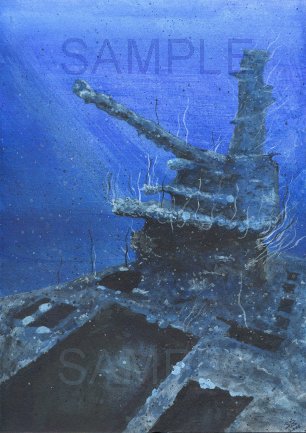
This was a controversial exercise carried out in
Bikini, in the Pacific, by the Americans to monitor the effects of nuclear
weapons on military targets. Apogon,
together with 70 other vessels, were to be destroyed by atomic bombs
during peacetime. Some of the
other vessels which suffered this same fate included Apogon’s
sister submarine, Pilotfish; the US aircraft carrier Saratogo;
the battleship Arkansas; and the Japanese battleship Nagato,
notorious for launching the attack on Pearl Harbour.
USS Apogon was sunk during atomic bomb test “Baker” on
25 July 1946. Divers can still find her lying upright where she fell in
180-feet of water in Bikini Lagoon. The
US Government declare that it is safe to dive in the area today as
background radiation is reported to be less than that of a large city.
USS
Apogon - Technical Details
Balao
Class Submarine
Displacement: 1870 tons surfaced, 2391 tons submerged
Length: 311'7” Beam: 27'3" Draft: 16'10"
Speed: 20 knots surfaced, 9 knots submerged
Armament: 1 3"/50 or 1 4"/50 or 1 5"/50, 6 bow and 4
stern 21” torpedo tubes
Diesel engines, surfaced/electric motors, submerged
Keel laid at Portsmouth Naval Dockyard, Kittery, Maine on 9 December
1942
Built at Electric Boat Co., Groton
Commissioned 16 July 1943 with LCdr Walter P. Schoeni in command
Decommissioned 29 April 1946
Struck from the Navy list on 25 February 1947
|